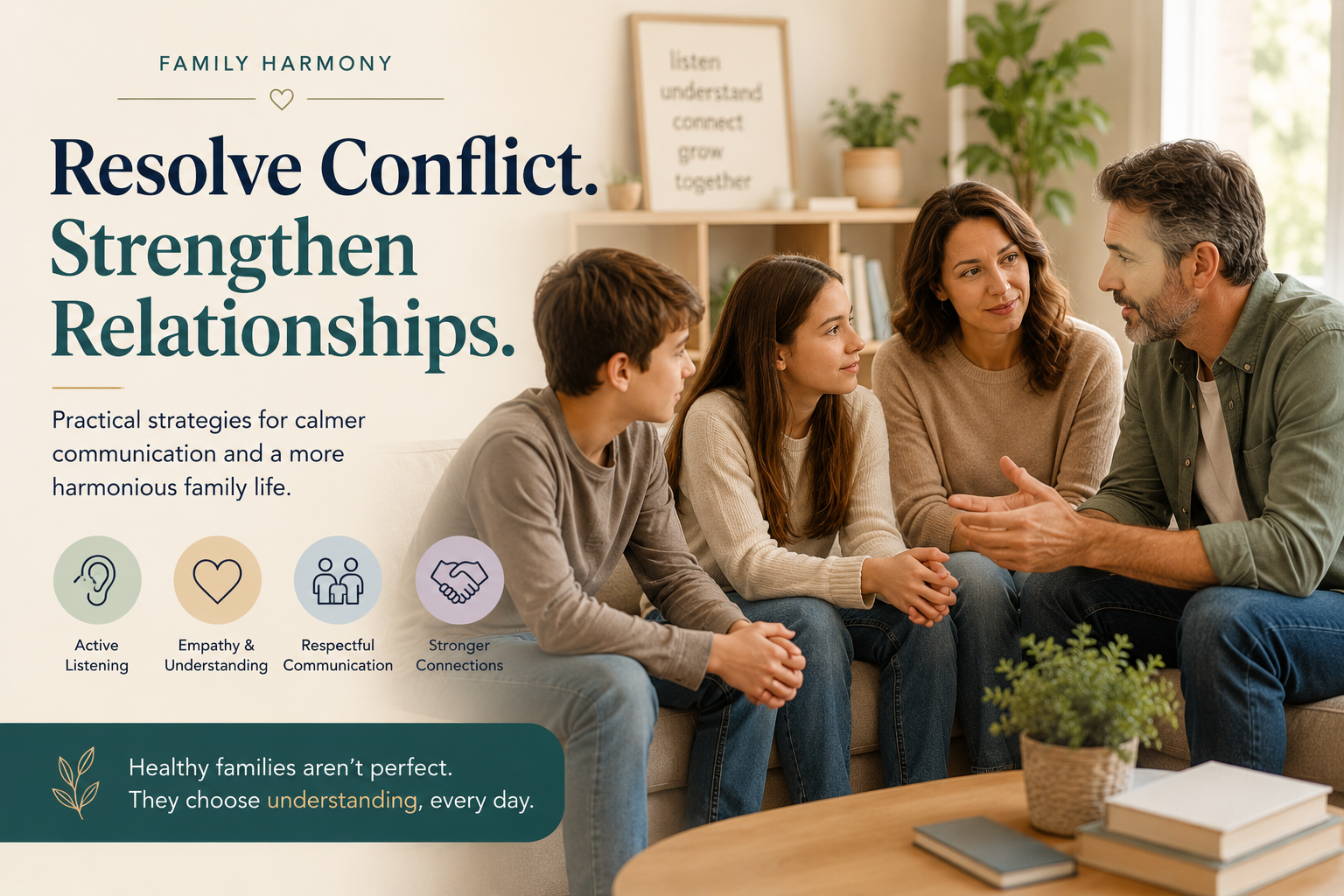
How to Resolve Family Conflict Without Constant Arguments
Family conflict is a natural part of relationships, but when disagreements become frequent or emotionally intense, they can negatively affect communication, trust, and emotional wellbeing. Learning effective conflict resolution strategies can help families communicate more calmly, strengthen relationships, and create a healthier home environment.
🗣️ 1. Practice Active Listening
Many family disagreements escalate because individuals feel unheard or misunderstood. Active listening involves:
- giving full attention,
- avoiding interruptions,
- and responding calmly.
Listening carefully helps reduce defensiveness and improves understanding between family members.
❤️ 2. Focus on Understanding Rather Than Winning
Conflict resolution should not be about proving who is right or wrong. Instead, focus on understanding each person’s feelings and perspective. Empathy can significantly reduce tension and improve emotional connection.
⏸️ 3. Pause Before Reacting
Strong emotions can lead to impulsive reactions. Taking a short pause before responding can help individuals communicate more thoughtfully and prevent arguments from escalating.
💬 4. Use Respectful Communication
Avoid:
- shouting,
- blaming,
- criticism,
- or hurtful language.
Using calm and respectful communication encourages healthier discussions and improves trust within the family.
🧩 5. Identify the Root Cause of Conflict
Many family disagreements are not only about the immediate issue. Stress, unresolved emotions, grief, financial pressure, or communication difficulties may contribute to ongoing conflict.
Understanding the deeper cause can help families address issues more effectively.
🌱 6. Encourage Emotional Intelligence
Recognising and managing emotions is an important part of healthy family relationships. Emotional intelligence helps individuals respond with patience, empathy, and self-awareness during difficult conversations.
🤝 7. Be Open to Compromise
Healthy conflict resolution often requires flexibility and willingness to find balanced solutions that respect everyone’s needs.
💡 Key Takeaways
- Calm communication reduces conflict escalation
- Active listening improves understanding
- Emotional intelligence strengthens relationships
- Respect and empathy are essential for healthy family dynamics
Signs of Unhealthy Communication in Families
Family communication often doesn’t fall apart suddenly. It usually shifts quietly over time—through repeated patterns, misunderstandings, and things left unsaid. Many families don’t realise there’s a problem until conversations start to feel tense, avoided, or emotionally draining.
Unhealthy communication isn’t always loud or obvious. In fact, it can look very normal from the inside. But over time, it can create distance where there used to be connection.
This article will help you recognise some of those patterns—not to assign blame, but to build awareness and create space for healthier ways of relating.
When communication starts to feel unsafe
One of the clearest signs of unhealthy communication is when people no longer feel emotionally safe speaking openly.
This can show up in subtle ways:
- Holding back thoughts to avoid conflict
- Choosing silence instead of honesty
- Feeling anxious before certain conversations
- Expecting criticism or dismissal
When people begin to self-censor regularly, communication stops being open and becomes protective.
Common patterns that quietly damage connection
Many families experience these patterns without naming them:
1. Passive-aggressive communication
Instead of saying what is wrong directly, frustration comes out indirectly through tone, sarcasm, or withdrawal.
2. Emotional shutdown
One person may disengage completely during disagreements, leaving issues unresolved and emotions unprocessed.
3. Constant correction or criticism
Even small conversations can feel like they’re being evaluated rather than shared.
4. Talking at each other instead of with each other
Conversations become instructions, lectures, or arguments rather than exchanges.
5. Bringing up the past repeatedly
Old issues are revisited during new conflicts, making resolution feel impossible.
These patterns often develop over time and can feel “normal” within the family system.
The emotional impact of unhealthy communication
When communication becomes strained, the emotional impact can be significant:
- People feel misunderstood or unheard
- Small issues escalate quickly
- Emotional distance grows
- Trust in conversations weakens
- Family members begin to avoid difficult topics altogether
Over time, it becomes easier to disconnect than to engage.
Why these patterns develop
It’s important to recognise that unhealthy communication usually doesn’t come from bad intentions.
It often develops because:
- People repeat what they experienced growing up
- Emotional expression was not modelled or encouraged
- Conflict was avoided rather than resolved
- Stress or pressure limits emotional patience
Understanding this helps shift the focus from blame to awareness.
What healthy communication starts to look like
Healthy communication doesn’t mean families never disagree. It means disagreement doesn’t damage connection.
You may start to notice:
- People listening without interrupting
- Space for different opinions without judgement
- A calmer tone during difficult conversations
- Willingness to revisit and repair conversations
- Emotional honesty without fear of punishment
These shifts often start small.
Gentle reflection
You might find it helpful to reflect on:
- Do I feel heard when I speak in my family?
- Are there topics I avoid to keep the peace?
- What usually happens when conflict arises?
- Do conversations leave me feeling closer or more distant?
There are no right or wrong answers—only awareness.
Closing thought
Communication shapes the emotional climate of a family. When it becomes strained, it affects everyone. But even long-standing patterns can shift when they’re noticed with honesty and care.
Small changes in how we speak, listen, and respond can slowly rebuild safety and connection where it has been missing.
📘 Learn More
Explore more evidence-based family conflict strategies in:
Behaviour Change Interventions for Conflict Resolution in Families